Injection Molding
Why Injection Molds Cost What They Cost: 7 Drivers
Cavitation, steel, slides, texture, tolerance and cycle: what actually moves a mold quote from three to thirty thousand dollars, and what you can change.
2026-10-14 · Injection Molding · 11 min read · by MOMAKING Engineering
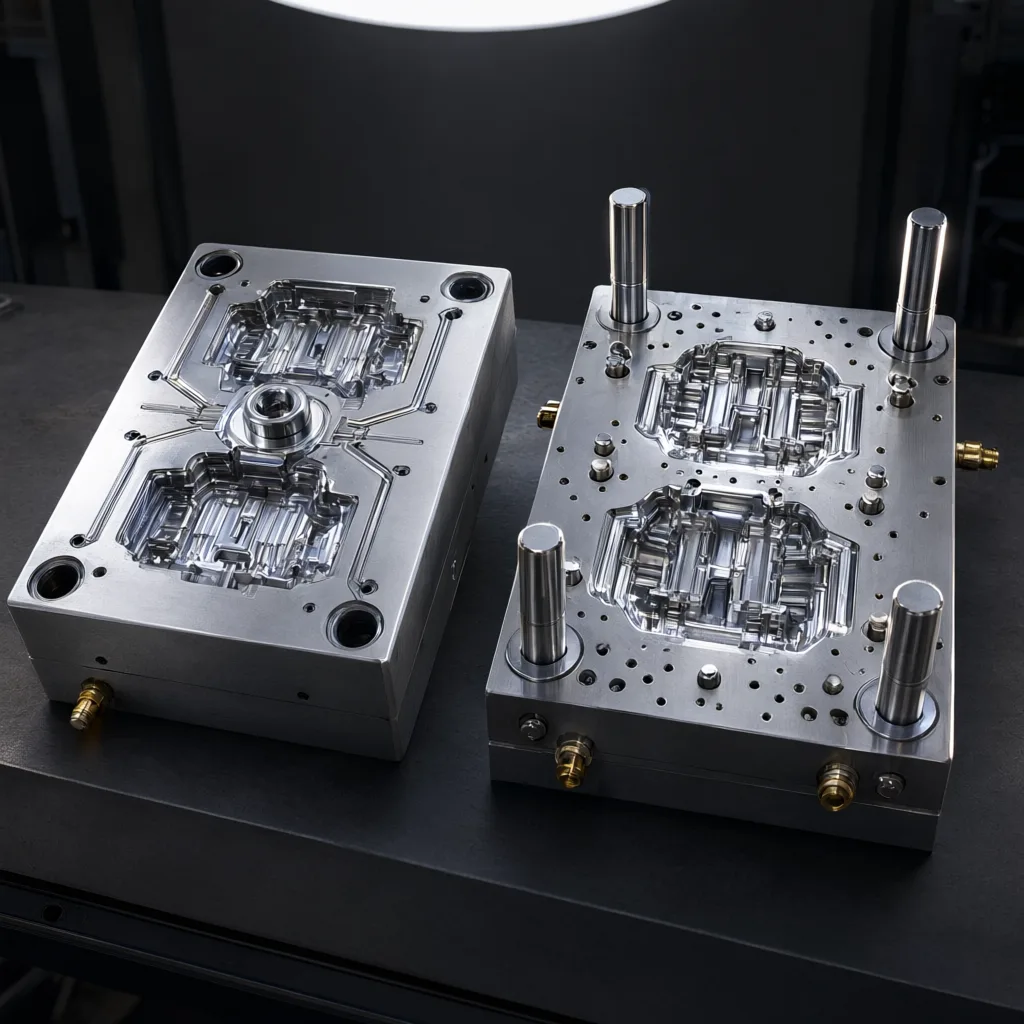
"How much for a mold?" arrives as one number in most buyers' heads. It is actually seven numbers multiplied together, and knowing which ones you control is the difference between a $4,000 tool and a $40,000 one — for the same part.
Driver 1 — Cavitation: The Biggest Lever
A single-cavity tool cuts one part per cycle; an 8-cavity tool cuts eight, from a tool that costs maybe 2.5x as much. Cavitation is therefore a volume decision, not a quality one: at 100k shots the multi-cavity saves cycle time you can buy elsewhere; at 1M shots it is mandatory. Bring annual volume to the RFQ and the cavitation proposal comes with the quote — bring nothing and you guess.
Driver 2 — Steel Grade and Hardness
P20 pre-hard workhorse sets the floor. 718H buys stability in larger plates. NAK80 takes EDM texture and mirror polish. S136 stainless resists corrosive resins (flame-retardant and glass-filled grades eat plain steel) and holds polish for a million shots. Each step up the ladder is 10-30% of tool price. The right question: what resin, what life, what surface — in that order.
Driver 3 — Side-Actions: Slides and Lifters
Every undercut in your part is a mechanism in the tool: slides ride dovetails, lifters rise with the opening, unscrews rotate with the stripper plate. Each one is precision ground, hardened, fitted — and each is a future maintenance point. Undercuts that could become parting-line splits, snap fits that could become separate clip parts, or bores that could core straight are worth ten tool-hours of debate. Our DFM marks every undercut with its cheapest resolution.
Driver 4 — Texture and Polish
SPI A3 polish is routine. Mirror A1 on a large cavity is hand labor measured in days. EDM texture (VDI 12 through VDI 42, or mold-tech leather/grain series) adds texture-master fees, EDM hours, and — the hidden one — steel that must be NAK80-grade to take it. A cosmetic face is a budget line; a textured cosmetic face is a bigger one; both are honest once named.
Driver 5 — Tolerance and the Steel Rework Reserve
A tool holding ±0.05 mm on critical features is cut, measured, tried, and usually corrected once or twice. Shops that promise "T1 perfect" simply haven't tried your part yet; the professional move is a correction reserve (we quote a T1-T2-T3 lane) and free trial shots so corrections cost steel-hours, not surprise invoices.
Driver 6 — Cooling Complexity
Bored straight water lines are cheap. Baffle/bubbler circuits moderately more. Printed-conformal cooling (SLM inserts with boundary-following channels) is the new expensive option that pays only at high cycle counts — it can cut cycles 15-30% on deep cores, which at 500k shots returns the premium fast, and at 50k never does. Cycle math decides; bring the volume again.
Driver 7 — Runner and Gate System
Manual-deburred cold runners are cheapest tool and priciest labor. Hot-runner systems cost $1,500-$8,000+ in the tool but delete runner waste and sprue handling — they flip economical somewhere above the 100k-shot range on small parts, lower on expensive resin. Valve-gate systems add more control for cosmetic parts. The part weight, resin price and volume solve that equation together.
What You Can Actually Change This Week
- Volume forecast: real numbers pick cavitation and hot-runner, guesses pick your wallet.
- Undercut audit: move one undercut to the parting line; that alone can be four figures.
- Cosmetic map: texture only what a customer sees; A3 on hidden faces is money burned quietly.
- Resin grade: non-corrosive resin allows cheaper steel on most cavities.
Want the seven-driver breakdown on your part? Send STEP plus annual volume to opheliamyers221@gmail.com — the quote itemizes them by name, so you can haggle with physics instead of the salesperson.
Get this part priced
Upload your STEP file - AI quote in seconds, engineer-verified quote within 24 hours.