Reference
3D Printing Materials Guide — Resin vs Nylon vs Metal, With Rules
The shortlist MOMAKING engineers quote from: property reality, heat limits, cost behavior and the decision rules that stop expensive material mistakes.
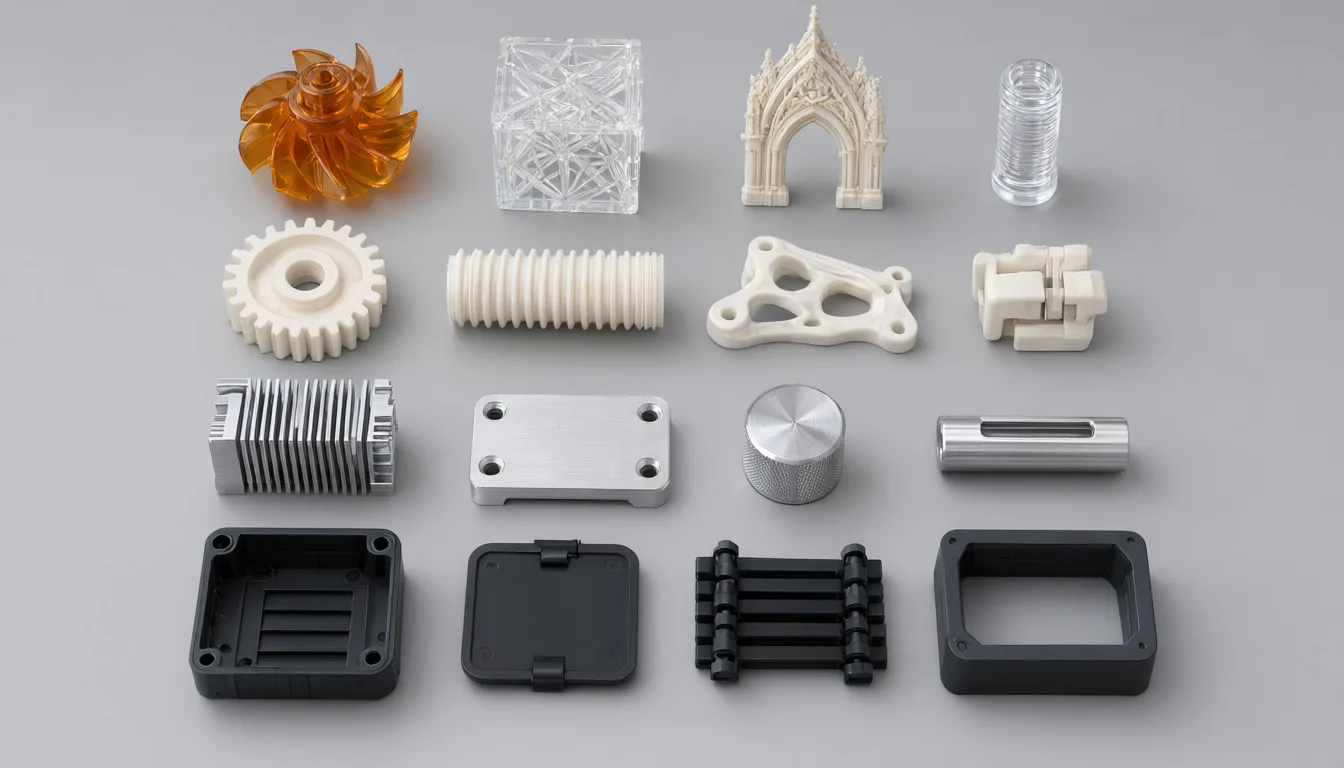
Every 3D printing quote is secretly a materials question. Twenty dollars of powder or resin can make a part that survives the design review or one that cracks in the samples box. This guide is the shortlist our engineers work from — and the selection rules they apply when you tell them what the part has to do.
3D Printing Materials Comparison
| Material | Detail / Strength | Toughness | Heat (continuous) | Colors / Look | Pick it for |
|---|---|---|---|---|---|
| Standard resin (photo-curable acrylate) | Detail king | Fair - brittle thin | ~60 °C | Clear / white / grey / black | Visual masters, clear fluidics, fit checks |
| Tough resin (ABS-like) | Good | Good, flexes | ~80 °C | White / black / grey | Drop-tested shells, clips, snap assemblies |
| High-temp resin | Very good | Rigid, stiff | ~200 °C short | Amber | Hot-gas fixtures, airflow masters, engine-bay mocks |
| Clear resin | Best clarity | Fair | ~50 °C | Optical-grade clear | Windows, manifolds, light pipes |
| PA12 nylon (SLS) | Isotropic, tough | Tough, living-hinge OK | ~90 °C | Grey / white / black dyed | Functional end-use, ducts, jigs, batches |
| PA + glass bead nylon | Stiff, stable | Good | ~100 °C | Dark grey | Flat plates, low-warp mechanisms |
| TPU (SLS elastomer) | Flexible | Elastic, rebounds | ~80 °C | Grey | Gaskets, bumpers, flexible couplings |
| AlSi10Mg (SLM) | Near-wrought | Good, T6 available | ~200 °C | Metallic grey | Lightweight structure, heat sinks, drone parts |
| 316L stainless (SLM) | Wrought-class | Ductile | ~500 °C | Steel, polishable | Corrosive duty, filters, marine hardware |
| Ti-6Al-4V (SLM) | Highest specific | Good | ~350 °C | Titanium grey | Frames, implant-route hardware, brackets |
The Selection Rules We Actually Use
- Must be seen through or perfectly smooth? Clear or standard resin; nothing else optically competes.
- Must survive drops, flexes and a toolbox? Tough resin at prototype stage, SLS nylon once the design freezes.
- Runs hot or touches fuel? High-temp resin short-term, nylon for duty, metal above ~120 °C continuous.
- Carries structural load at minimum mass? Topology-optimized Ti-6Al-4V or AlSi10Mg in SLM.
- Outdoor or UV life? Never plain resin — dyed/sealed nylon or painted metal wins the decade.
- Thousands of identical units? Stay in SLS nylon until we quote the molding crossover — usually between 5k and 20k units depending on part size.
Cost Reality per Family
Resin prices by displaced volume and platform occupancy — small detailed parts are cheap, big hollow shells get careful (drain holes mandatory). SLS prices by packed build volume and is the cheapest printed family at quantity because hundreds of parts cure together. Metal is a different economy: machine hours, powder handling and post-processing put parts in the tens-to-hundreds of dollars each, which is exactly why the 1/10/100 quote curve and the machining-crossover check matter so much. The AI engine prices all three families on the same screen — you see nylon-vs-resin-vs-metal deltas before choosing, not after.
Data Sheets, Certs and Regulated Routes
Standard material data sheets ship with every quote. Production programs get lot traceability on powder and resin, witness-coupon mechanical data on metal builds, and certified-grade sourcing where your regulation demands it (implant-grade Ti, food-contact nylon grades, flame-rated resins) — flagged honestly at RFQ because certified stock changes lead time and price. Not sure? Describe the duty in two sentences and get a material pick with reasoning from a real engineer: opheliamyers221@gmail.com / WhatsApp +1 315-623-3808.
Frequently Asked Questions
Which material is best overall?
Can I compare prices across materials before ordering?
Do you stock all these materials?
Which material paints and glues best?
Material Selection Walkthroughs: Three Parts, Three Different Winners
Case 1 — the dishwasher latch that started as resin. A snap-latch arrived as a tough-resin print request; the duty sentence changed the answer: 3,000 cycles per year at 60-70 °C behind a detergent splash zone. Tough resin softens at 60 °C long-term, and detergent attacks acrylate networks on contact. The shipped answer: PA12 (SLS) latch body, a TPU gasket printed in the same order, one glass-filled PA clip where stiffness held the spring — all three in the same two-day build. Resin would have been $8 cheaper for week one and a warranty claim for month six.
Case 2 — the drone arm that wanted nylon and needed metal. Weight targets said printed nylon at 18 g; the crash budget said 40 g impacts into concrete at closing speed. Nylon survived the crash and lost the screw boss on the second hit. AlSi10Mg SLM with a printed lattice rib pattern hit 23 g with a metal boss that takes screw torque. Titanium would have saved two more grams at triple the price: they shipped aluminum and spent the weight saving on a bigger battery instead — which is what material conversations should do, feed the system.
Case 3 — the clear impeller and the unasked question. Clear-resin water-pump demo units looked perfect for three weeks, then crazed at the hub during their first hot day in a window-lit showroom. UV-stabilized tough-clear plus a hub redesign (thicker, radius-relieved) replaced it; the spec had carried one hero property, clarity, and no second one, heat. When a material choice carries a hero property, name the second one it must survive — the four-line RFQ block below exists exactly for that.
The Four-Line RFQ Block That Fixes 90% of Material Errors
Most material mistakes happen in the first message: “print this in nylon” when nylon was wrong, or “cheapest resin” when the part had a duty. Four lines at the top of any RFQ fix it, and cost nothing to write. (1) Environment — indoor/outdoor, temperature range, what fluids it touches, UV exposure. (2) Mechanics — does it carry load, flex repeatedly, take screw torque, or nothing stronger than its own weight? (3) Appearance — seen by customers? needs color, clarity, paintability, or is grey-powder finish fine? (4) Lifespan — demo for Friday, one-year product, or ten-year part? With those four lines an engineer picks family, grade and finishing tier and writes the reasoning next to the price — the rare free line item in manufacturing. Withhold them and the AI engine takes your literal material word at face value; the part then arrives exactly as requested, which is sometimes the tragedy.
The guide's heat figures are continuous-service shop experience with these specific formulations, not brochure maxima; ask for the specific datasheet with your quote and the test method next to any number it prints. Where a spec sits at the boundary of two materials, the quote prices both and says which one it would ship and why.
Common Material Mismatch Patterns (and the Line Item That Fixes Each)
Patterns repeat across industries. The outdoor part in plain resin: yellowed and brittle within a year at a windowsill; fix is dyed-and-sealed nylon or painted metal, a line item both cheaper than the replacement order. The hot-side clip in standard resin: softens at 55 °C, a dishwasher door away from its datasheet; fix is high-temp resin or PA12, a two-line quote delta. The “strongest material” instinct: the Ti bracket that fractured at a stress riser the nylon version flexes past — strength is the wrong axis when the duty is impact; the right ask is a duty sentence, not a hero material. The clear part with a hidden spec: nobody names UV, heat or solvent and clarity alone wins the pick, then the shelf or the sun or the fuel rejects it; the fix is the four-line block below, filled in. The printed-metal reflex: some 200-piece aluminum parts are cheaper five-axis machined with no post-processing at all; the crossover line item on the quote (print vs machine, same drawing) is free and shows the number. Each pattern's fix is a line in the quote, invisible only if the material conversation stays invisible — which is precisely why we put the reasoning beside the material pick.
Get this part priced
Upload your STEP file - AI quote in seconds, engineer-verified quote within 24 hours.